The Typo That Wasn’t: CCHD Quietly Comes Full Circle
Has the experiment in “power” theology run its course?

I have waited most of my adult life for a typo on the bishops’ USCCB website. It is not a good thing to admit about yourself.
But, I found a typo and it hit hard. The United States Conference of Catholic Bishops (USCCB) keeps a page for its annual Catholic Campaign for Human Development (CCHD) collection, you know the one, it’s the second collection that passes through American parishes each November, and this year on the Sunday after this is published. This page was the top search result I had gotten. I stared at the page in disbelief at what I saw: the page does not describe the campaign as a national program. Rather, it reads: “The Chicago Catholic Campaign for Human Development (CCHD) is the Archdiocese of Chicago’s anti-poverty program. Founded in 1970, Chicago CCHD’s mission is to address the root causes of poverty in the Archdiocese through grants and education programs.”1 I took a screenshot because it was so jarring!
You think you know this story. Saul Alinsky; community organizing; the sixties buying a permanent address in the Church’s collection basket; the boycott crowd at the gates. Empowerment! Fifty years of argument about the Catholic Campaign for Human Development have been compressed, by both friends and enemies, into that cartoon. This is not that essay. The organizers are real, they were present at the founding, and the founders said so out loud — I will quote them doing it. But the organizers are not what ran the movie. What ran the movie never made a sound. It has no press releases, no votes, no plenary debates. Call it what it is: the quiet.
The CHD power mission, drafted the night before adoption by the Bishops
The campaign begins in August 1969, at Cumbermere, a house in Ontario run by the religious artist Catherine de Hueck Doherty, where the Alinsky-formed priests — Dave Finks, Geno Baroni, the future bishop John McCarthy and others — drafted the fundamentals of a national Catholic poverty fund.2 Three months later the National Conference of Catholic Bishops (remember that this was the actual bishops’ conference before they merged it into the USCCB) voted on the resolution. Its operative sentence had been written, by Finks with Bishop James McHugh, the night before the vote. Literally, “the night before Dave Finks and I drafted the language,” as McHugh put it, and it was, in the words of the scholarly study that later dug all this up, “language used for the first time in NCCB legislative history”:3
“There is an evident need for funds designated to be used for organized groups of white and minority poor to develop economic strength and political power in their own communities.”4
Not charity. Power. It was being organized, funded, permanent. The men who wrote it knew exactly whose method they were adopting; Finks said of Alinsky, “I loved Saul. He stood me on my head and showed me a radically different way to see the world, the church, and democratic politics.”5
The project’s executive architect was a thirty-nine-year-old bishop serving as the first episcopal General Secretary of the conference: Joseph Bernardin. He later described himself as “directly involved in this exciting endeavor,” and the conference has since made him its campaign’s “commemorative saint.” As its patron, the CCHD gives a “Cardinal Bernardin New Leadership Award,” and says he “nurtured the vision” and remained “a strong supporter” as Archbishop of Cincinnati and then of Chicago.6 Remember both cities. They matter.
The very first Campaign for Human Development collection was taken up on Sunday, November 22, 1970. It returned $8.4 million! At the time it was reported to be the largest single collection in the history of the American Catholic Church to date.7
Set that basket down in your mind. We’ll pick it back up at the end of this essay.
Chicago Keeps Fifty Percent
The rules the bishops wrote for themselves were simple. The conference’s own guidelines record the Administrative Board’s 1970 action: dioceses could retain up to twenty-five percent of the collection; amounts beyond the designated share “should not be retained.”8 In February 2003, Catholic New World, the Chicago archdiocesan paper, reported that of the $835,495 the archdiocese’s Catholics gave in 2001, “25 percent stayed in the archdiocese.”9 Normal. Compliant. Then the photocopiers started working.
In November 2013, Cardinal Francis George, not a fringe figure by any measure, the chairman of the conference’s doctrine committee, a man who had just finished presiding over the archdiocese’s abuse crisis — signed a collection letter for the CCHD weekend that contained this sentence: “50 percent of the collection’s proceeds stay here in our archdiocese.”10 The same language appears in his 2014 letter.11 There was no plenary session debate at the bishops conference. There was no public explanation. A cardinal signed a parish bulletin, and a national program with a twenty-five percent rule became a fifty-fifty enterprise in the largest archdiocese in the midwest, and no one outside the archdiocese was asked to notice. (Truly Chicago here. Even the silence as if nobody wanted to be named as noticing!)
The doubling outlived its author. Cardinal George died in April 2015; his successor’s office (you know who) publishes an annual CCHD report with the formula printed in it: fifty percent to the national office, thirty-eight percent to local grants, six percent education, six percent administration — twelve percent overhead against the conference’s two percent advisory cap.12 In 2019 the archdiocese’s Catholics gave the campaign roughly $575,000, and the campaign’s national and local channels returned about $782,000 to Illinois organizations. On this line item, Chicago is a net recipient of the national Catholic CCHD money.13
Nowhere in fifty years of official documents will you find the conference approve the doubling. Nowhere will you find it say anything to stop it. That is the quiet: not a decision, the absence of one, renewed annually by photocopy.
Then that got me wondering. Did anybody else do this? Is there just a quiet campaign to alter the deal further?
A Quick Tour of the Dioceses
Once you know to look for this quiet, you cannot stop seeing it, because the dioceses of the United States have been conducting a fifty-year experiment in it. I pulled the record on twenty-four of them, including the big ones, the compliant ones, the ones someone will inevitably ask about.
For every diocese that publishes its math, the math looks legal to the 25% rule. Lexington’s annual collections decree, signed by the bishop, prints “(75% to CCHD, 25% for diocese)” right in the CCHD line.14 Cincinnati keeps its local grants at a $10,000 cap and its share at the legal 25%.15 Houston, Atlanta, Miami, Baltimore, the Archdiocese of Kansas City in Kansas (“remits 75%,” audited), St. Louis with its own cheerful CCHD microsite — all 25%, all on the record.16 St. Louis is worth a moment precisely because it is so clean: it keeps its honest quarter for small parish projects while the seventy-five percent it sends away funds, among others, Metropolitan Congregations United, its Gamaliel-lineage organizer, at $75,000. Compliance and organizing are not contradictions. These appear to be going with the flow with some local flavor added.
Then the quiet begins, softly, in the spreadsheets. Denver’s audited financial reports show the CCHD line at $80,753 in 2020, then $214 in 2021, then $53,022 in 2022.17 Two hundred and fourteen dollars. One archdiocese, one year, one national collection — a rounding error with a mitre on it. No announcement accompanied the $214; none accompanied its disappearance the next year.
Fort Worth is the cleanest specimen. The diocese’s special collections calendar, a PDF published annually, updated yearly, carried the CCHD collection in 2020, 2022 and 2023, through the entire contentious tenure of Bishop Olson, the guy everyone loved to quote as a CCHD critic.18 The 2024 calendar does not mention CCHD at all. The November slot was later reassigned to a partnership collection with the Archdiocese of Kumasi, Ghana. The transition was announced in no newspaper, debated by no presbyterate, recorded in no act. A bishop who campaigned against nothing in particular deleted a national program from a PDF, and the program did not survive. Chicago wrote theirs up, while Olson just erased it.
Tyler, Texas, completes the thought in reverse. Under Bishop Strickland, the diocese’s collections page listed no CCHD anywhere — the slot’s function was covered by a diocesan charity collection, and the conference’s own coordinator listing for Tyler simply read “VACANT.”19 Unfortunately, his successor apparently discovered this “one quiet trick” and the CCHD is back on the page with the full conference boilerplate, “25% of your contribution stays within your own diocese,” and lists scheduled special collection dates for 2026 and 2027.20 Pope Francis removed the bishop and the diocese rejoined the collections system. Participation in CCHD has become, in real time, a marker of communion… errr ahem… I think they’d chose the word Unity.
In the survey I found that Erie, Pennsylvania, has found the cheapest exit of all: keep the plumbing, change the envelope. The chancellor’s letter of June 2025 announced that Bishop Persico “has announced a name change for the Catholic Campaign for Human Development… it is now called the Local Needs Collection,” and asked parishes to update their offering envelopes “before placing orders for 2026.”21 Nothing in the letter says the remittance stops. The name, not the money, is what became unsayable.
I couldn’t not look at Springfield, Illinois. They replaced the campaign outright in 2012 with Bishop Paprocki’s Diocesan Campaign for Justice and Hope. This tidy campaign keeps everything local, caps grants at $5,000, requires a pastor’s signature approving the grant, and screens applications doctrinally. My favorite effect: the Alinsky-lineage Faith Coalition was locked out at the gate.22
There’s contagiousness to the idea. Oakland followed the same model in 2025 under Bishop Barber with a “Diocesan Campaign for Mercy,” openly announced as CCHD’s “local successor,” screened against abortion, euthanasia, and “tolerating racism.”23 New York under Cardinal Dolan stopped collecting for CCHD altogether in favor of Catholic Charities’ Campaign for Charity and Justice, sending the campaign perhaps $75,000 of a half-million-dollar take as an administrative fee. There wasn’t total silence in response, as the CCHD’s own director told America Magazine he knew of no other diocese doing it and hoped the model would not spread.24
Spread? Too slow. I say we make it a pandemic!
Twenty-four dioceses, one gradient: loud compliance, quiet compliance, quiet skipping, quiet deletion, quiet replacement, quiet renaming. And at the far end, alone, one archdiocese that did the quietest thing of all, when Chicago took double what the rules allow, kept the collection, and said fifty percent out loud only in the places where nobody would ask about it.
The Collection Basket Votes, Audited
The money kept the score the bishops would not keep. From the conference’s own audited financial statements: the CCHD collection peaked at $10.8 million in fiscal 2017, collapsed to $4.1 million in the pandemic year, and has recovered since only to the eight-million range: $8.8 million in 2024, $8.1 million in 2025, but it looks like it may never go back to the peak.25 Grants, the thing for which the money is collected, fell from $15.7 million in 2017 to $2.3 million in 2024, and the campaign spent its reserves to a negative $2.8 million balance in 2023 before retrenchment turned the line positive again.26 The conference’s budget chair told the November 2025 plenary bishops meeting that the 2026 budget balances partly through “reorganization and cutbacks” in the CCHD.27 The campaign is now roughly a tenth of the national collections pool; the retirement fund for religious outscores it three to one.28
We need to be precise here because precision is the only sharp weapon we’ve got. This is not a cliff. Nobody threw the CCHD out of the window. Rather, it is a long exhale. A slow sigh of expiring. The collection has been roughly flat the last two years, and no bishop’s conference voted to defund anything. What happened is that the American laity, without meetings, manifestos, or a single boycott day, stopped putting money in the basket at the rate they used to, and the audited books now record what the pews decided first.
Which brings back the basket (remember I told you we’d pick it back up) from 1970. $8.4 million, the largest collection in American Catholic history. The 2025 collection: $8,062,574.29 Fewer dollars, fifty-five years later, from a Church twice the size. In 1970 money, the first collection was worth around $65 million; so in inflation-adjusted terms, the campaign now runs at about an eighth of its founding value. The institution did not kill the campaign. The basket did, slowly, and the quiet has simply been catching up to the verdict.
It’s Nice to be Printing This Here (Where it all started after all)
Here the story becomes personal.
From the 1970s through the 1990s, essentially two institutions in American Catholicism kept this file open: The Wanderer newspaper, and the Wanderer Forum Foundation, which produced the research — Thomas Pauken’s paper to the 1985 National Wanderer Forum, “Alinsky’s Success — CHD’s Hidden Agenda”; Stephanie Block’s reports on the IAF and ACORN money; a ninety-page Wanderer special in 1996, “The Legacy of CHD”; a formal report to the bishops themselves in 1997.30 The charge they made, for decades, was immediately dismissed loudly as slander, kooks, or worse (sometimes bishops and the USCCB itself said these things about us). But you heard it here first that the campaign was an organizing machine in charitable clothing, funded by parishes it would not serve, answerable to donors it would not inform.
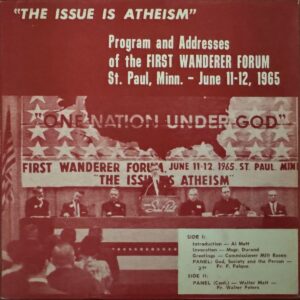
Which makes this file’s history partly my own, and I will put myself in it honestly. I was in elementary school when Pauken’s paper came out. I was out of chemical engineering and working when Block’s 1996 special and the 1997 report to the bishops came out. I was not yet attached to the Foundation, just a reader of the weekly Wanderer, and buying the Forum’s reports and discussing them with whoever would discuss them. The red booklet is in my closet as I write this; it is not a research copy, it is the copy I have kept since the year it went out.
What I remember best is the reception, which is to say the lack of one. Most people outside of a few were not disturbed. To some, the CHD report was taken as further evidence of the smoke of Satan — Paul VI’s phrase for what had entered the temple of God. To others, it was shrugged off as something that did not concern them. Nothing moved. But a shrug is how a laity votes before it learns to vote, and a basket is where shrugs accumulate. The discussion of that file stayed open in kitchens and parishes and Catholic bookstores with Saturday-morning coffee klatches, in a laity that read the reports, argued about them, and remembered — and to that laity the vindication, when it finally arrived, did not arrive as news. It arrived as a receipt, a tally of the basket where shrugs replaced dollars.
The vindication of our reports has come in installments, each one from a surprising source. In 1998, Theological Studies, a Jesuit-run scholarly journal, published Lawrence Engel’s documentary history of the campaign’s Alinsky genesis, restoring the founding sentence to the record from the bishops conference’s own minutes, with the founders’ own concessions attached.31 In 2008, after the ACORN grants and the embezzlement indictments, the chairman of the bishops’ own CCHD subcommittee, Bishop Roger Morin, conceded at a press conference that tracking CCHD dollars inside a grantee was “virtually impossible” because the money was pooled.32 The oversight claim, conceded on the record, by the oversight.
Then came the industrialization. Oversight work and inspecting the campaign became a genre: annual grantee audits, open letters to the conference, a standing press of exposure. The genre claims credit for what the basket did. The audited dates will not carry the claim. The audits began in 2015, and the collection rose to its highest point in history two years later, $10.8 million.33 The one truly catastrophic year was the pandemic year, and nobody audits a pandemic. There was a most recent “open letter” in May 2024, and despite these noisy demands the following November collection rose twenty percent, from $7.3 million to $8.8 million.34 The basket was doing its own thing, at its own pace, and had been since before the watchdog genre existed. There is a long, quiet departure that neither side of the argument moved, because neither side was driving. That is why I looked at and derived the trend from the audited statements. The bishops’ numbers are worse for the bishops than any auditor’s numbers could be, and they are the only ones that keep time.
The foundation that delivered those reports to the bishops in 1985 and again in 1997 is the foundation that was accused of inventing facts, detection, slander and being dismissed as kooks for telling the truth. I am here as its president, seeing this with my own eyes: the conference’s national website now states as plain fact what the Forum told everyone 41 years ago and since.
The Quiet is Getting Loud in the USCCB
In June 2024, in Louisville, the bishops finally said the quiet part in a closed room: Bishop Paprocki proposed sunsetting the campaign, Archbishop Naumann echoed him, Cardinal Tobin defended it, and by the conference’s own accounts the room broke decisively the other way — “overwhelming support,” one bishop called it “a turning point,” and the National Catholic Reporter’s verdict was that “the critics… overreached.”35
They had not overreached. They had misjudged the venue. The laity had already voted, in audited dollars, for eleven straight years; the room hadn’t caught up to the basket. And in August 2025, twenty-three bishops — four archbishops among them — filed the formal proposal to “transform” the campaign by 2026: half the collection retained locally, half sent to poorer dioceses, Catholic school scholarships added to the eligible uses.36
Read that number again. Fifty percent, local. This is the full circle, and it gets stated once: the campaign has come home to the archdiocese that kept half of it, and now a bloc of the bishops conference proposes to make every diocese Chicago.
What the reformers do not seem to have noticed is that the quiet was never their discovery. It was their inheritance — and the organizers of 1969 asked for “Economic strength and political power,” funded at scale, in churches. It looks like the laity have silently caught on and are using the power they’ve had all along these 55 years. Those alinskian organizers of 1969 didn’t even realize what they may have woken up. They may have meant Alinsky’s loud, organized revolution; instead, they empowered the quiet shrug of indifference.
Full Circle Indeed
I began by confessing to a petty pleasure in a typo. It wasn’t really an “aha!” moment once I looked at the page and realized the page was deliberately promoting various local CCHD programs (hence, “CCHD collections” as the name of the website section). But it gave me a flash that helped me see what should be obvious about the whole thing at this point and it is worse for the institution than a typo would be: there was no typo. A typo is a wrong sentence. The bishops’ website has a right sentence, errr, rather a sentence that correctly describes fifty-five years of quiet feeding the hopes of “empowerment” and this new theology of “power.”
“The Chicago Catholic Campaign for Human Development (CCHD) is the Archdiocese of Chicago’s anti-poverty program.”
Instead of seeing the context, read it as testimony and the story is this: the largest national collection in American Catholic history came back in 1970 with $8.4 million. But last November the same yielded only $8,062,574. The laity never held a convention. They just stopped giving, and the website, at last, stopped pretending. Now, this leaves us with a bit of suspense at what this weekend’s collection will bring? Does the annual collection bounce back? Or will it continue this slow prolonged sigh of decline into exhaustion?
That’s the surprising thing to me that I had not considered before. Despite the shock of the Acorn scandal or other scandals, despite the constant tracking to Alinskian organizing, despite the palpable communist revolution fomented in and by many grantees, the collections had been seemingly unaffected. Instead, the quiet sighs, both of lay people and seemingly of many bishops, seem to be taking their toll on the machine of empowerment.
The sad part is that we really won’t know the answer until the audited financials are published, which will take a year or more.
I guess we need to quietly shrug and wait for the basket.
—
- USCCB, “CCHD Collection,” usccb.org, https://www.usccb.org/committees/catholic-campaign-human-development/cchd-collection (last visited November 9, 2026). ↩︎
- Lawrence J. Engel, “The Influence of Saul Alinsky on the Campaign for Human Development,” Theological Studies 59 (1998): 639–665, https://theologicalstudies.net/articles/the-influence-of-saul-alinsky-on-the-campaign-for-human-development/ (last visited November 9, 2026). ↩︎
- Ibid. (McHugh interview; “language used for the first time in NCCB legislative history”). ↩︎
- Ibid., quoting the Resolution on the Crusade Against Poverty, November 1969, as printed in Daring to Seek Justice at 69, and in the Minutes of the Seventh General Meeting of the NCCB, Nov. 10–14, 1969. ↩︎
- Ibid., quoting Finks interview of Oct. 28, 1994. ↩︎
- USCCB, “Cardinal Bernardin New Leadership Award,” usccb.org, https://www.usccb.org/committees/catholic-campaign-human-development/cardinal-bernardin-new-leadership-award (last visited November 9, 2026); Engel, supra note 2 (Bernardin’s 1995 keynote: “as General Secretary… directly involved in this exciting endeavor”; “executive oversight of the design, development, and establishment of the CHD”). ↩︎
- Engel, supra note 2 (first collection Nov. 22, 1970; $8.4 million; “largest single collection in the history of the U.S. Catholic Church to that time”). ↩︎
- USCCB, One Church One Mission: Guidelines for National Collections (retention per Administrative Board action of Sept. 15–16, 1970; amounts beyond designated share “should not be retained”), https://www.usccb.org/resources/one-church-one-mission-guidelines-national-collections.pdf (last visited November 9, 2026). ↩︎
- Catholic New World, Feb. 16, 2003 (of $835,495 given in 2001, “25 percent stayed in the archdiocese”), https://legacy.chicagocatholic.com/archive/cnw2003/021603/newmexico_021603.html (last visited November 9, 2026). ↩︎
- St. Florian Parish bulletin, Nov. 17, 2013, collection letter signed Francis Cardinal George (“50 percent of the collection’s proceeds stay here in our archdiocese”), http://florian.hegewisch.net/bulletins/11-17-2013.pdf (last visited November 9, 2026). ↩︎
- St. Florian Parish bulletin, Nov. 9, 2014 (same 50% language), http://florian.hegewisch.net/bulletins/11-09-2014.pdf (last visited November 9, 2026). ↩︎
- Archdiocese of Chicago, CCHD Annual Report 2024, https://pvm.archchicago.org/documents/87254/6872141/CCHD+Annual+Report+2024_shorter.pdf/3d9d6389-b795-415b-870c-83de0fc049cc, and CCHD Annual Report 2022, https://pvm.archchicago.org/documents/87254/5073301/CCHD+Annual+Report+2022_JA_v1.pdf/f3916fa1-a3fb-46b2-beeb-0f631f0d835a (allocation formula 50/38/6/6) (last visited November 9, 2026); conference overhead advisory cap per USCCB guidelines, supra note 8. ↩︎
- Ibid. (2019 giving vs. Illinois awards; FY2023 collection $481,836). ↩︎
- Diocese of Lexington, “Annual Collections Ordered in the Catholic Diocese of Lexington for the Year 2027,” signed Most Rev. John Stowe, OFM Conv. (CCHD line: “75% to CCHD, 25% for diocese”), https://cdlex.org/wp-content/uploads/2026/01/COLLECTIONS-FOR-2027.pdf (last visited November 9, 2026); same language in the 2021–2026 decrees on file with the author. ↩︎
- The Catholic Telegraph, “Catholic Campaign for Human Development,” Nov. 8, 2023 (“Seventy-five percent of funds go toward national work, while 25% goes to local organizations”), https://thecatholictelegraph.com/catholic-campaign-for-human-development/; Archdiocese of Cincinnati CCHD page ($10,000 grant cap; 2026–2027 grant list), https://resources.catholicaoc.org/offices/catholic-social-action/task-forces-committees/cchd (last visited November 9, 2026). ↩︎
- Archdiocese of Galveston-Houston, “Anti-poverty program creates paths to the margins,” Texas Catholic Herald, Nov. 12, 2024 (25% stays local), https://archgh.org/news/anti-poverty-program-creates-paths-to-the-margins; Archdiocese of Atlanta, “Local Justice Programs Receive CCHD Grants,” Georgia Bulletin, Nov. 2011, https://georgiabulletin.org/news/2011/11/local-justice-programs-receive-cchd-grants/; Catholic Review (Baltimore), “Catholic Campaign for Human Development Awards $96,000 in Baltimore-Area Grants,” Feb. 2026, https://catholicreview.org/catholic-campaign-for-human-development-awards-96000-in-baltimore-area-grants/; Archdiocese of Kansas City in Kansas, Financial Report 2023–24 (“remits 75%”; $33,054 line), https://archkck.org/wp-content/uploads/2024/12/Financial-Report-23-24.pdf; CCHD St. Louis, “Grant Funding” (“Twenty-five percent… stay in the St. Louis Archdiocese”), https://cchdstl.org/grant-funding/; national grant figures for St. Louis organizations from USCCB, “CCHD Approved Grants 2026,” https://www.usccb.org/resources/cchd-approved-grants-2026.pdf (last visited November 9, 2026). ↩︎
- Archdiocese of Denver, “Second Collections” (75/25 split stated), https://archden.org/pastoral-outreach/second-collections/; Archdiocese of Denver audited financial reports FY2020–FY2025 (CCHD lines $80,753; $214; $53,022; $57,346; $59,099; $47,590), https://archden.org/financial-reports/all-reports/ (last visited November 9, 2026). The cause of the 2021 figure is not publicly explained; the figure is asserted, the cause is not. ↩︎
- Diocese of Fort Worth, Special Collections Calendars: 2022 (CCHD listed), https://web.archive.org/web/20220814131250/https://fwdioc.org/Special-Collections-Calendar-Revsised-2022.pdf; 2023 (CCHD listed), https://web.archive.org/web/20220814114729/https://fwdioc.org/Special_Collections_Calendar_2023_.pdf; 2024 (CCHD absent), https://web.archive.org/web/20240224070817/https://fwdioc.org/Special-Collections-Calendar-2024.pdf; 2025 (Kumasi partnership collection in the former slot), https://web.archive.org/web/20240617045748/https://fwdioc.org/Special-Collections-Calendar-EN-2025-April24.pdf (last visited November 9, 2026). ↩︎
- Diocese of Tyler, “Second Collections” page: no CCHD entry in the Strickland-era captures of Oct. 24, 2021, https://web.archive.org/web/20211024002841/https://www.dioceseoftyler.org/secondcollections/, Sept. 30, 2022, https://web.archive.org/web/20220930012600/https://www.dioceseoftyler.org/secondcollections/, and Nov. 17, 2023, https://web.archive.org/web/20231117041012/https://www.dioceseoftyler.org/secondcollections/; current listing (CCHD restored) at https://www.dioceseoftyler.org/secondcollections/ (last visited November 9, 2026). ↩︎
- Ibid. (25% language; 2026–2027 dates). ↩︎
- Diocese of Erie, Chancellor’s letter of June 24, 2025, transmitting the 2026 Special Collections Schedule (“Local Needs Collection”; envelope instruction), https://www.eriercd.org/images/sections/finance/pdf/2026B-special-collections.pdf (last visited November 9, 2026). ↩︎
- Diocese of Springfield in Illinois, “Campaign for Justice and Hope” (DCJH structure, caps, screens), https://dio.org/prolife/campaign-for-justice-and-hope/; Catholic Times (Springfield), “Looking at effective programs that address poverty,” https://dio.org/catholic-times/looking-at-effective-programs-that-address-poverty/ (last visited November 9, 2026). ↩︎
- Diocese of Oakland, “Diocesan Campaign for Mercy” (Bishop Michael Barber, Oct. 15, 2025: “the local successor to the Catholic Campaign for Human Development”), https://www.oakdiocese.org/diocesan-campaign-for-mercy/ (last visited November 9, 2026). ↩︎
- America Magazine, “New York switches to a pilot program during annual CCHD collection. Did parishioners notice?,” Nov. 22, 2017 (≈$75,000 administrative remittance on ≈$500,000 raised; CCHD director Ralph McCloud’s comments), https://www.americamagazine.org/faith/2017-11-22/new-york-switches-pilot-program-during-annual-cchd-collection-did-parishioners/ (last visited November 9, 2026). ↩︎
- USCCB Consolidated Financial Statements FY2010–FY2025, National Collections schedule, CCHD column (collection: $10.77M FY2017; $4.1M FY2020; $8.06M FY2025), posted at USCCB, “Financial Reporting,” https://www.usccb.org/about/financial-reporting (last visited November 9, 2026). ↩︎
- Ibid. (grants and donations: $15.67M FY2017; $2.3M FY2024; net assets end-of-year: $46.1M FY2015; −$2.8M FY2023; $4.2M FY2025). ↩︎
- Catholic Review, “USCCB has ‘balanced budget’ for now, but priorities, resources under review,” Nov. 2025 (Archbishop Checchio budget update; CCHD “reorganization and cutbacks”; $15M investment draw), https://catholicreview.org/usccb-has-balanced-budget-for-now-but-priorities-resources-under-review/ (last visited November 9, 2026). ↩︎
- USCCB Consolidated Financial Statements FY2025, supra note 25 (CCHD $8.06M of $80.6M national collections; Retirement Fund for Religious $28.2M). ↩︎
- Ibid. and Engel, supra note 2. Comparison is nominal; CPI conversion (~8×) is approximate and offered as order-of-magnitude only. ↩︎
- Thomas W. Pauken, “Alinsky’s Success — CHD’s Hidden Agenda,” paper, 18th National Wanderer Forum, Washington, D.C., Oct. 18–19, 1985, Wanderer Forum Foundation; Wanderer Forum Foundation, A Commentary on the Campaign for Human Development Prepared for the Catholic Bishops of the United States (1997), https://bellarmineforum.org/a-commentary-on-the-campaign-for-human-development-prepared-for-the-catholic-bishops-of-the-united-states-1997/ (last visited November 9, 2026); The Wanderer, “The Legacy of CHD” (1996 special, 90 pp.) (the author’s own copy, kept since publication; scan pending). ↩︎
- Engel, supra note 2. ↩︎
- EWTN News, “Catholic bishops cut all funding to ACORN,” Nov. 11, 2008 (Bishop Morin press conference: CCHD’s ability to trace funds “hampered by the co-mingling of Catholic dollars with other grants”), https://www.ewtnnews.com/world/us/catholic-bishops-cut-all-funding-to-acorn; New Oxford Review, “Louder Than Words,” Jan. 2009 (Morin “admitted in a press conference that it is virtually impossible to determine how CCHD funds were being used”), https://www.newoxfordreview.org/documents/louder-than-words (last visited November 9, 2026). ↩︎
- Lepanto Institute, “US Bishops Take Up Anti-Poverty Collection Despite Lack of Transparency,” Nov. 19, 2024 (“Since 2015, the Lepanto Institute has investigated the CCHD’s grant-making activities”), https://www.lepantoin.org/wp/us-bishops-to-take-up-anti-poverty-collection-despite-lack-of-transparency/; “Prominent Catholics to US Bishops: Shut Down Controversial Campaign,” LifeSiteNews, May 28, 2024 (open letter of May 27, 2024), https://www.lifesitenews.com/news/catholic-leaders-beg-us-bishops-to-cancel-agency-funding-marxist-pro-abortion-pro-lgbt-groups/ (last visited November 9, 2026). ↩︎
- USCCB Consolidated Financial Statements, supra note 25 (collection: $10.77M FY2017 peak; $7.3M FY2023; $8.8M FY2024). ↩︎
- NCR, “Behind closed doors, ‘overwhelming support’ for bishops’ anti-poverty program,” June 2024 (Louisville executive session; Paprocki proposal; Naumann; Tobin; “a turning point”; “the critics… overreached”), https://www.ncronline.org/opinion/ncr-voices/behind-closed-doors-overwhelming-support-bishops-anti-poverty-program (last visited November 9, 2026). On the departure of CCHD executive director Ralph McCloud in 2024, reported by The Pillar as occurring amid financial controversy; no adjudication of personal conduct is asserted here. ↩︎
- The Pillar, “U.S. bishops shift from community organizers to Catholic schools” (varium of Aug. 6, 2025; 23 signatories listed; 50/50 split; scholarship provision), as published by California Catholic Daily, https://www.cal-catholic.com/u-s-bishops-shift-from-community-organizers-to-catholic-schools/ (last visited November 9, 2026). ↩︎
This article, The Typo That Wasn’t: CCHD Quietly Comes Full Circle is a post from The Bellarmine Forum.
https://bellarmineforum.org/the-typo-that-wasnt-cchd-quietly-comes-full-circle/
Do not repost the entire article without written permission. Reasonable excerpts may be reposted so long as it is linked to this page.